Bison, wolves and elk in a Yellowstone winter
Winter leaves Yellowstone white and quiet, and its animals easier to find. Herds move down to the valleys, dark coats stand out against the snow, and a good guide knows which pullouts to try first. This guide covers where each animal tends to be and which tours take you there. No tour can promise any of them.
Why winter helps the animal watcher
Snow does two useful things for anyone hoping to see animals. It pushes many of them down from the high country to river flats and low valleys, where grass is easier to dig out.
It also turns the ground white. A dark bison or wolf shows up against it from far away.
Yellowstone, the first national park (established in 1872), covers about 2.2 million acres (8,990 km²). Even so, in winter much of its wildlife gathers in a handful of places that guides check every day.
Cold slows animals down as well. Bison and elk save energy by moving as little as they can, so a herd you spot in the morning may still be in the same meadow at lunchtime.
No operator on this site guarantees a sighting, and each one says so in its own listing. When the snowcoach season runs compares the winter months for snow depth and daylight.
Bison on the snow roads
Bison are the animal you are most likely to see, and the one that sets the pace of a snowcoach day. They swing their huge heads from side to side to plough snow off the grass, a whole herd at once in the same field.
Groomed roads make easy walkways for them. When a herd ambles down the road the snowcoach stops and waits, sometimes for a long while. Listing photos from the snowcoach operators show bison filing right past the coaches.
On very cold mornings, frost settles on their faces and shaggy backs.
The snowcoach days of BrushBuck Wildlife Tours, from ~$2,089, and Horizon Travel Team, from ~$2,249, both follow the Madison River in from West Yellowstone, a stretch where American bison are often seen near the water.
Scenic Safaris comes in from the south past Yellowstone Lake instead. Old Faithful in winter by snowcoach follows each route stop by stop.
Elk on the refuge and at Mammoth
The surest elk in the region are not inside Yellowstone at all. Thousands spend the winter on the National Elk Refuge, established in 1912 on the edge of Jackson, Wyoming.
BrushBuck's four-day trip opens its second morning with a horse-drawn sleigh ride among more than 5,000 elk there.
Not on that tour? The Double H Bar sleigh ride, from ~$43, will take you to the same herd and scores 4.7 from 260+ reviews. It takes about 1.5 hours in all, with 45–60 minutes on the sleigh.
Thin-snow weeks expose its catch, when the sleigh turns into a bumpy wagon. Hotel pickup is not part of the price either.
Up on the park's northern range, elk often bed down on the slopes and lawns around Mammoth Hot Springs, steps from the steaming terraces. Yellowstone Hiking Guides, from ~$292, gives about 30 minutes to the Mammoth boardwalks, which is usually enough for a few elk photos with steam behind them.
Wolves in Lamar Valley
Wolves were reintroduced to Yellowstone in 1995 and 1996, and the Lamar Valley on the northern range soon became the classic place to watch them.
It is also the one prime area you can reach on wheels in winter. The northern road stays open to cars all year when the weather allows, leaving the North Entrance at Gardiner in Montana and passing Mammoth on its way to Lamar and Cooke City.
Wolves are usually far across the valley, so a spotting scope matters more here than a long lens. Wolves in Yellowstone tells the story of the packs.
Yellowstone Hiking Guides spends about 2 hours in Lamar with binoculars and a group spotting scope, for six guests at most. Recent reviewers report seeing wolves through the scope, and they praise guides such as Josh for pulling over whenever an animal appears.
Nobody can promise wolves. A day with only distant dots is normal. This is a road tour, not a snowcoach, so it never reaches Old Faithful. Our comparison of the ways into the winter park weighs that trade-off.
A day spent scanning Lamar Valley
Yellowstone Hiking Guides picks up at 6 am in West Yellowstone before later stops in Big Sky and Bozeman. Hot drinks and a picnic lunch are part of the day. It costs ~$292 plus the North Entrance fee and scores 5.0 from 14+ reviews on Viator.
Smaller animals to scan for
Once you have seen your first hundred bison, the guide's real skill shows in the smaller finds. These turn up on some days and not on others.
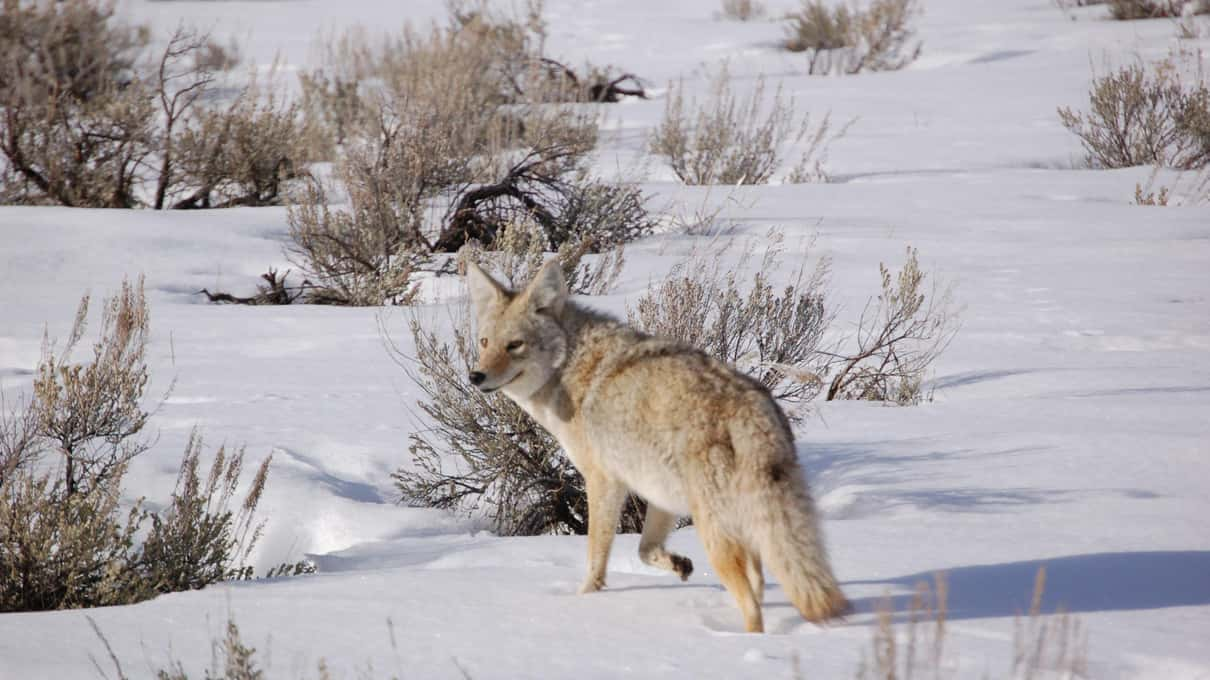
- Coyotes, common on open flats and often mistaken for wolves at a distance, though smaller and slimmer in the face
- Red foxes, which listen for mice under the snow and then dive in nose first
- Bighorn sheep on steep, rocky slopes, listed by both BrushBuck and Good Trip Adventures
- Moose, more likely in the willows of Grand Teton, where BrushBuck's first-afternoon drive gives the better chance
- Bald and golden eagles, perched in trees above the rivers
- Trumpeter swans and river otters, sometimes, on stretches of water the thermal areas keep free of ice
BrushBuck and Yellowstone Hiking Guides both provide binoculars, which turn a brown speck on a ridge into a ram you can name. What to wear on a Yellowstone winter tour covers keeping your fingers warm enough to hold them.
Bears stay in their dens
Grizzly and black bears spend the winter asleep and mostly come out from about March. A January snowcoach day will not show you one, and any pitch that hints otherwise is overselling.
The oversnow season ends around mid-March, just as the first bears stir. No tour on this site counts bears among its sights.
A private day on the northern range
Groups that want every hour shaped around animals can book the Good Trip Adventures private wildlife day, from ~$973. It collects you from lodging between Bozeman and Gardiner in a luxury SUV.
About 3 hours go to Lamar Valley with a picnic lunch. There is also the offer of a short hike or snowshoe at the Calcite Springs overlook. It holds 4.9 from 20+ reviews.
Price is the catch. It is quoted per person for a private group, which makes it several times the cost of the shared van, and like that van it is a road tour, not a snowcoach.
How close you may get
Park rules set a minimum gap of 25 yards (23 m) for bison and elk, and 100 yards (91 m) for wolves and bears. Feeding any wild animal is illegal.
Bison look sleepy, yet they can charge without warning. The people hurt by them are almost always the ones who walked up for a closer picture.
On a snowcoach the driver decides where to stop, and when a herd fills the road you stay inside. Along the northern road guides park at pullouts and set up the scope, so you watch from a respectful distance anyway.
Binoculars do more than walking closer ever will. Our cost guide adds up the fees for each kind of trip, and choosing a gateway town shows which base puts you nearest the animals you most want to see.